Days for Girls is excited to announce the latest Menstrual Health (MH) Country Snapshot series on Cambodia! This snapshot marks the eleventh installment of the Country Snapshot series, and the second completed for a country in Asia.
The goal of the Country Snapshots series, which started in 2022, is to provide MH experts and advocates with easily accessible, research-based summaries of the MH conditions, rights, and policies of individual countries.
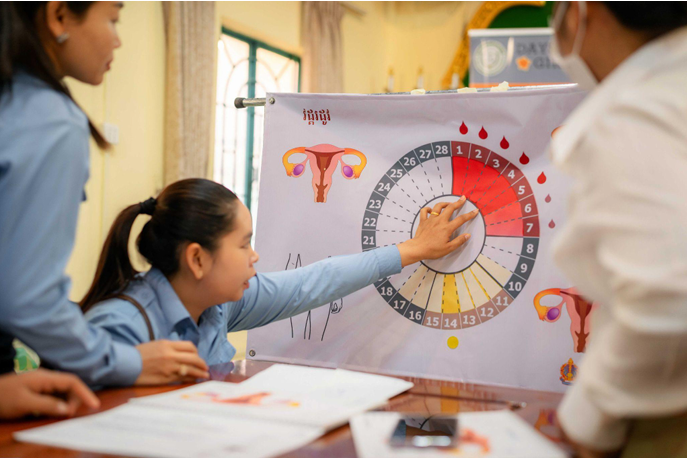
The Cambodia Snapshot is especially significant for Days for Girls, as we have been invested in strengthening the national MH curriculum. Days for Girls has collaborated with local organizations as well as the Cambodian Ministry of Education, Youth and Sport (MoEYS) over the past five years to integrate menstrual health education into schools and empower Cambodian teachers with knowledge and resources to feel confident teaching this subject.
Within the last decade, Cambodia has made significant progress in advancing sexual and reproductive health and rights, MH education, and water, sanitation, and hygiene (WASH) standards. Local organizations and the Cambodian government are actively investing in MH, expanding resource access, and improving the rights and lives of those who menstruate.
The Cambodian Snapshot was supported and peer-reviewed by MH experts in Cambodia, including those at the United Nations Population Fund Cambodia, Cambodia Rural Students Trust, and Days for Girls Cambodia. Through this collaboration, the Snapshot produced valuable insights into the MH environment for women and girls in Cambodia.
Here are three key findings from the Snapshot:
1. According to one survey of secondary school students, 64% agreed that menstruation should be kept a secret, and 48% agreed that menstruating girls could not go to school (DfGI 2025).
2. About 17.8% of Cambodians live below the poverty line, while almost half of Cambodian children under 18 years of age are considered to be “multidimensionally
poor” (UNICEF, 2023).
3. Six out of ten primary schools in Cambodia lack access to WASH facilities (UNICEF Country Programme). These are just a few of the findings identified in the Cambodia Snapshot that demonstrate the realities of MH and WASH needs in Cambodia. DfG is excited to share this Snapshot with our community of MH experts and advocates around the world and to continue improving MH conditions in Cambodia. Read the full Cambodia Menstrual Health Country Snapshot in Khmer here and in English here.