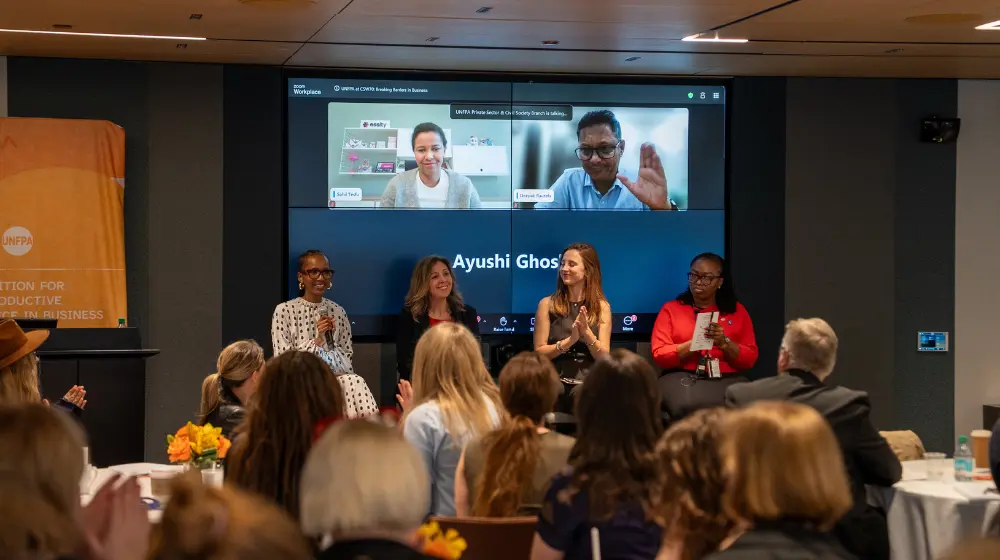
2026 marked the 70th United Nations Commission on the Status of Women, and Days for Girls (DfG) was privileged to lead and contribute to a variety of parallel and side events at this prestigious gathering of government, civil society, private sector, and advocacy leaders. By participating in three separate events this year, DfG elevated menstrual health programming as a life course experience through three unique lenses: workplaces, schools, and community participation.
Breaking Barriers in Business: A policy and practice blueprint for closing the menstrual health gap at work
Eva Fernández Martín, DfG Development Director, served as a panelist for the side event “Breaking Barriers in Business: A policy and practice blueprint for closing the menstrual health gap at work” organized by the Coalition for Reproductive Justice in Business, the UNFPA, Essity, Shahi Exports, and the Permanent Mission of Finland.
Focused on the intersection of women’s health, economic performance, and sustainable growth, DfG spoke about the Period Positive Workplace, a collaborative initiative engaging businesses to meet employee menstrual health needs via a free certification. DfG leads the steering committee for the Period Positive Workplace.
Surprisingly, cost isn’t the primary barrier to businesses becoming Period Positive Workplaces. ISSA, The Association for Cleaning & Facility Solutions and a member of the Period Positive Workplace steering committee, conducted a survey of facility managers and discovered that the number one reason companies don’t provide period care is that they had never considered doing so. Most facility managers indicate that their staff or customers haven’t asked for products – leading them to doubt if these solutions are really needed.
“The goal should be 21st-century bathrooms where period products are fixtures, just like toilet paper and soap,” said Fernández Martín. “Customers and employees can be advocates in creating Period Positive Workplaces by making period products an expectation in the bathroom, not a luxury.”
This UN official side event offered an opportunity for DfG to articulate why investing in menstrual health makes good business sense both for employee well-being and the employer bottom line.
Empowering Educators: Implementing teacher training for comprehensive menstrual health education
Days for Girls hosted “Empowering Educators: Implementing teacher training for comprehensive menstrual health education” at the NGO CSW parallel conference. Together with the Cambodian Ministry of Education, Youth, and Sport and Cambodia Rural Students Trust, this session highlighted DfG’s five-year teacher training program in Cambodia that supports educators in delivering accurate, comprehensive menstrual health education.
The event opened with an introduction to DfG’s teacher training curriculum and the inception of the program by DfG Chief Programs Officer, Leyla-Isin Xiong. Cambodia Program Managers Monineath Seng and Pheak Phoun then provided an overview of the monitoring, learning, and evaluation data. The data revealed that through comprehensive teacher training, outcomes improve for both teachers and students in menstrual health knowledge and attitudes.
“Speaking from my experience as a young Khmer girl, I used to feel extremely shy when talking about menstruation,” said Seng during her presentation. “In our culture, these topics are not openly discussed. When we began this project, we asked ourselves a simple but critical question: Who has the greatest power to change this experience for students? And the answer was teachers. They shape not only what students learn, but also how students feel about themselves and the world around them.”
Jessica Palti, Co-Founder and Director of Cambodia Rural Students Trust, discussed the value of peer-led education with a special focus on engaging male instructors. Palti also shared about Project G, a DfG Social Enterprise operating in Siem Reap, Cambodia, that engages young people as menstrual health trainers to apply this peer-to-peer methodology in rural Cambodian schools.
To close the session, DfG Senior Global Advocacy Director Diana Nelson and Youth Leadership Committee member Alisa Nudar introduced the audience to student-centered learning techniques that have proven critical to the success of DfG’s programming in Cambodia. By demonstrating best practices to engage students in active recall and peer-engaged critical thinking, Nelson and Nudar closed the session with practical steps that attendees can apply to their existing education programs.
You can watch the complete recording of this parallel event HERE.
Economic Empowerment of Women Entrepreneurs, Gender Equality and SDG’s
DfG Chief Executive Officer Tiffany Larson represented Days for Girls at the NGO CSW parallel event “Economic Empowerment of Women Entrepreneurs, Gender Equality and SDG’s” hosted by TCF Global, BPW Business Incubator, and BEC Global. This event, in its 12th year, showcased a variety of enterprise and NGO leaders that center economic empowerment in their missions to advance gender equality.
Larson shared about the DfG mission and our unique approach to advancing menstrual health via local leadership. DfG’s Social Enterprise program—which has created jobs for 451 people, 85% of whom are women— engages local leaders not only as product manufacturers, but as on-the-ground advocates leading community conversations about menstruation while creating jobs that seed markets, championing their work to local governments, and providing DfG with essential contextual feedback to improve our product and programs. Collectively, the program has reached more than 1.4 million women with menstrual health solutions.
In addition to DfG’s Social Enterprise program, Larson highlighted DfG’s postpartum care pilot that recently took place in Nakuru, Kenya. This maternal well-being initiative emerged organically during program delivery, as recurring questions surfaced about postpartum bleeding. “It became clear that a postpartum module within our menstrual health curriculum was needed,” Larson said. Needs assessments conducted across two counties in Kenya found that only 37% of mothers received postpartum care education prior to delivery, and just 24% had access to a postpartum kit to manage bleeding afterward.
“The project made a significant impact on the lives of 868 expectant and postpartum mothers in Nakuru County,” Larson noted. “It also demonstrated an innovative, market-driven, locally led approach that created jobs and supported a local business.”
This parallel event allowed DfG to connect with other organizations that prioritize amplifying community voices in programming, both as advisors and as active participants for economic development and gender equality advocacy.