


Highlighting Menstrual Health Research at the UNC Water & Health Conference
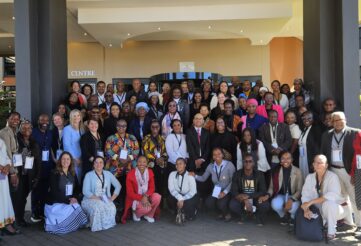
Days for Girls (DfG) attended the 2025 University of North Carolina Water & Health Conference, a cutting-edge research forum for academia, civil society, and the private sector to connect on the current state of water, sanitation, and hygiene (WASH).
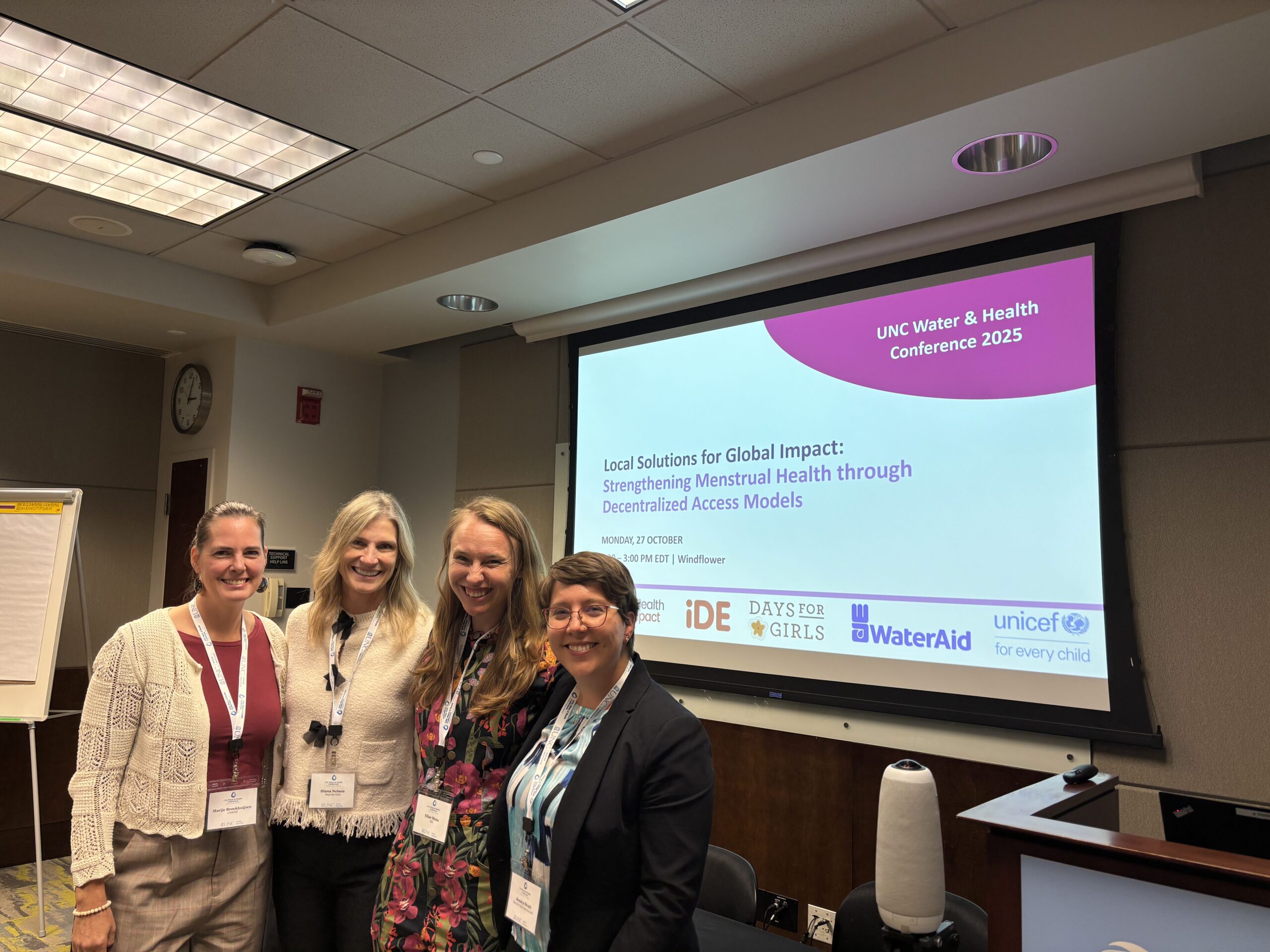
DfG was pleased to contribute two projects to the conference program: serving as co-host for the side event Local Solutions for Global Impact: Strengthening Menstrual Health through Decentralized Access Models and presenting the academic poster Evaluating Menstrual Health Pedagogical Interventions: Knowledge Acquisition, Attitudinal Shifts, and Confidence Development in Cambodian Teachers.
Strengthening Menstrual Health through Decentralized Access Models
 The side event on decentralized access models was co-hosted by Days for Girls, UNICEF, WaterAid, iDE, and Menstrual Health Action for Impact (MHAi). UNICEF and MHAi opened the session with a definition of decentralized access models as “redistributing decision-making power and resources to community-led groups in the product value chain”. Decentralized access models are rooted in the idea that local leaders are best positioned to seed markets, bridge gaps, and deliver relevant solutions to problems in their community. The presentation introduced how these models can be applied to menstrual health in low- and middle-income countries through localized disposable pad manufacturing, reusable pad manufacturing, and menstrual product sales.
DfG and iDE offered case study examples of market-based decentralized access models. DfG shared our unique learning-forward model that currently supports 58 Social Enterprises and over 250 employees in 21 countries. DfG Social Enterprises not only manufacture and sell DfG washable pads but also deliver menstrual health education and engage in advocacy. Thoughtful insights arose from group discussion on the benefits and challenges of such market-based approaches, and the role of parent organizations as powerful aggregators to support local solutions.
Key advantages of decentralized access models, like the DfG Social Enterprise program:
- Quality materials. DfG can source high-quality fabric and other materials in bulk to deliver cost savings to Enterprises.
- Research & development. DfG iterates upon user feedback to deliver a functional product design and relevant educational curriculum.
- Market identity. DfG offers trusted branding that Enterprises can utilize in their local market.
- Global consistency. DfG Enterprises can leverage existing frameworks and learnings for quality control, monitoring & evaluation, and policy advocacy.
Watch the complete side event recording HERE.

Evaluating Menstrual Health Teacher Trainings in Cambodia
DfG’s second contribution to the UNC Water & Health Conference was an academic poster showcasing evaluation data from our menstrual health teacher training in Cambodia.
In partnership with the Cambodian Ministry of Education, Youth, and Sport, and Cambodia Rural Education Support Organization, DfG developed and implemented a 3-day teacher training curriculum as part of the “Menstrual Health for Gender Equality Program” within schools and teacher education colleges from May to August 2024. The objective of this program was to increase access to timely, accurate, well-delivered menstrual health education that is both age-appropriate and culturally relevant.
The study measured changes in 256 teachers’ knowledge, confidence, and attitudes on menstrual health after participating in the training. Pre-and post-test questionnaires were administered to gauge baseline knowledge, confidence, and attitudes, and assess changes following the teacher training.
Prior to the training, teachers faced significant knowledge gaps, held negativeattitudes, and lacked confidence to provide instruction on menstrual health. After teachers received accurate menstrual health education and teaching techniques, they felt more confident to deliver the same knowledge to their students.
This poster demonstrated how delivering effective menstrual health education in schools requires systemic changes, beginning with teacher education. Read more about DfG’s ongoing teacher training programs in Cambodia and view the presented poster in English and Khmer HERE.
Spotlighting Menstrual Health Within Research Forums
The UNC Water & Health Conference offered a presentation of rigorous research in the WASH sector, and DfG is honored to have been able to communicate learnings from our global initiatives with the academic community.
But there is still work to be done. While menstrual health was on the agenda at the conference, it was far from center stage:
- Only 8% of side events had menstrual health as the foremost topic (4/50)
- Only 2% of verbal presentations focused on menstrual health (2/96)
- Only 5% of poster presentations focused on menstrual health (4/75)
Days for Girls is proud to contribute to the growing body of literature on menstrual health experiences, practices, and programmatic evaluations, and looks forward to continuing to highlight menstrual health in research forums worldwide.